TSA Powerlifting Program Guide — RPE-Based Periodization for Competition Prep
A complete breakdown of TSA Powerlifting by Bryce Lewis — 9-week block periodization, five variants, RPE training, and how to run it in RepCheck.
TSA (The Strength Athlete) programs are periodized powerlifting programs designed by Bryce Lewis and the TSA coaching team. They run 9-week cycles that peak into a competition or max testing week, using a mix of percentage-based loading and RPE (Rate of Perceived Exertion) to auto-regulate intensity. The programs focus exclusively on the three powerlifting competition lifts — Squat, Bench Press, and Deadlift — with targeted accessories to address common weaknesses in intermediate and beginner lifters.
The 9-Week Block Structure
All TSA programs share a similar 9-week arc, though the exact structure differs slightly between versions. TSA Intermediate 2.0 and TSA Beginner follow this framework:
| Phase | Weeks | Focus |
|---|---|---|
| Intro/Acclimation | Week 1 | Lower volume and intensity to ramp into the program |
| Progress | Weeks 2–4 | Build volume and intensity progressively |
| Deload | Week 5 | Reduce load and volume to shed fatigue |
| Intensify/Peak | Weeks 6–8 | Ramp up to near-max weights with lower reps |
| Test/Compete | Week 9 | Max out at a meet or in a mock meet |
TSA Intermediate 1.0 is slightly different — it builds continuously through Weeks 1–5 with no mid-cycle deload, then shifts to lower reps and higher intensity in Weeks 6–8 before testing in Week 9. TSA recommends a 1-week deload between cycles when running 1.0.
Volume and intensity move in opposite directions across the cycle. Weeks 1–4 have higher rep counts at moderate percentages. After the Week 5 deload, Weeks 6–8 flip to lower reps at higher percentages. Week 9 drops volume dramatically and focuses on maximal singles.
How RPE and Percentages Work Together
TSA programs aren't purely RPE-based — most working sets use prescribed percentages of your 1RM. RPE serves two roles:
For accessories: Exercises like rows, pull-ups, and presses use RPE targets (e.g., 3×10 at RPE 7–8.5) instead of fixed percentages, since there's no 1RM data for these movements.
For peak-phase top singles: Heavy singles before back-off sets are prescribed as RPE targets rather than percentages. For Bench Press, these RPE singles appear from Week 1 onward (e.g., 1×1 at RPE 7 on Day 4). For Squat and Deadlift, RPE singles are introduced in Weeks 6–8 as intensity ramps up. This lets you auto-regulate the heaviest work based on how you feel that day.
The RPE scale:
- RPE 7 — Could do 3 more reps
- RPE 8 — Could do 2 more reps
- RPE 9 — Could do 1 more rep
- RPE 10 — Maximum effort
If prescribed percentages consistently feel harder than the target RPE, lower your 1RM input.
TSA Intermediate 2.0 — The Main Program
The most popular TSA program. 4 days per week with horizontal pressing on every training day — Bench Press on Days 1, 2, and 4, plus a chest accessory (like Incline DB Press) on Day 3. This high pressing frequency is deliberate because bench responds well to it.
Day structure:
| Day | Main Lifts | Accessories |
|---|---|---|
| Day 1 | Squat (hypertrophy) + Bench (hypertrophy) | Close Grip Bench, Chest Supported Row, Band Pull-Aparts |
| Day 2 | Deadlift (main) + Bench (power) | Pendlay Row, Weighted Back Extension, Pull-ups |
| Day 3 | Squat (strength) | Incline DB Press, Leg Press/Hack Squat, Chest Supported Row, Athlete Movement of Choice |
| Day 4 | Bench (strength, with RPE singles) + Paused Deadlift (skill) | Feet-up Bench, Barbell Row, Lat Pulldown |
Weekly frequency: Squat 2×, Bench Press 3× (Days 1, 2, 4) + chest accessory on Day 3, Deadlift 2× (one competition, one paused).
Paused Deadlifts (paused 1 inch off the floor) develop positioning and bracing off the floor. They run at lower percentages than competition Deadlifts and progress alongside them across the 9 weeks.
The "Athlete Movement of Choice" on Day 3 is an autonomy slot — you pick an exercise that addresses a personal weak point (common choices: ab wheel, face pulls, lateral raises, bicep curls).
Example Week 1 intensities (% of 1RM):
| Lift | Day | Sets × Reps | % |
|---|---|---|---|
| Squat (hypertrophy) | Day 1 | 1×3 + 3×8 | 80% / 69% |
| Squat (strength) | Day 3 | 6×4 | 73% |
| Bench (hypertrophy) | Day 1 | 3×8 | 69% |
| Bench (power) | Day 2 | 5×4 | 72% |
| Bench (strength) | Day 4 | RPE 7 1×1 + 3×5 | ~RPE 7 / 77% |
| Deadlift (main) | Day 2 | 4×5 | 74% |
| Paused Deadlift | Day 4 | 4×4 | 67% |
By Week 8, the top singles hit RPE 8.5–9 and back-off sets reach 86–89% — close to competition-level intensity.
TSA Intermediate 1.0 — The Original
The first TSA program, described as a Daily Undulating Periodization (DUP) approach with a linear weekly pattern. Same 9-week structure and 4 days per week, but with different exercise selection and periodization details:
- Uses Chest Supported Row, Bent Row, Overhead Press, Close Grip Bench, and Barbell Glute Thrust as accessories
- Same deadlift structure as 2.0: competition deadlift on Day 2, paused deadlift on Day 4
- Bench volume is distributed slightly differently than 2.0
- Week 9 is a testing week with 1–3RM attempts on individual days (not a meet simulation)
TSA suggests alternating between 1.0 and 2.0 every few cycles for variety in loading style.
TSA Beginner
A 9-week program for newer powerlifters, running 4 days per week. Same block periodization structure as the intermediate programs, but with important differences:
- Uses exercise variations to build technique: Paused Deadlift (Day 2) and 3-Count Paused Bench Press (Day 4) alongside competition lifts
- Lower starting intensities with more gradual progression
- More accessory variety: glute work (Barbell Hip Thrust), quad isolation (Leg Press, Leg Extensions), plus dedicated arm and shoulder work
- Accessories use RPE-based prescription throughout
The Beginner program is designed to bridge into the Intermediate programs — once you stop making progress on it, move to TSA 1.0 or 2.0.
Male vs. Female Variants
Both TSA Intermediate 2.0 and TSA Beginner have dedicated female variants. The adjustments differ between programs:
For Intermediate 2.0, the female variant adds volume primarily on bench press — slightly higher percentages and additional sets on pressing movements — with minor increases on some accessory work as well.
For TSA Beginner, the female variant is broader — volume increases appear across multiple exercises including back work (more DB Row and Lat Pulldown sets), deadlift back-off sets, paused bench sets, and quad accessories, in addition to higher percentages on the main lifts (typically 1–2% higher).
Important: Max Input
TSA programs require your actual current 1RM — not 90% or 95% of it. This is different from 5/3/1 and nSuns which use a Training Max. The program's internal percentages already start at submaximal levels (67–80% in Week 1), so entering a Training Max would make the weights too light.
Keep the increment at 0 — the program's built-in periodization handles intensity increases week to week. You don't manually adjust weights between weeks. For Paused Deadlift, enter the same 1RM as your competition Deadlift. For 3-Count Paused Bench (Beginner), enter the same 1RM as your Bench Press.
If you miss reps, don't panic — continue the program as written. If RPE consistently overshoots, lower your 1RM input.
Who Is This For?
TSA Intermediate programs are for lifters with roughly 1–2+ years of powerlifting experience who want to prepare for competition or a structured testing phase. You should be comfortable with the competition lifts and at least familiar with RPE. The Beginner variant is for lifters with less than six months of powerlifting experience who want a structured introduction to competition-style training.
After completing the cycle, input your new 1RMs and run it again. TSA recommends alternating between Intermediate 1.0 and 2.0 across cycles for variety.
Running TSA in the RepCheck App
When you select any TSA variant in the RepCheck app, it asks for your current 1RM:
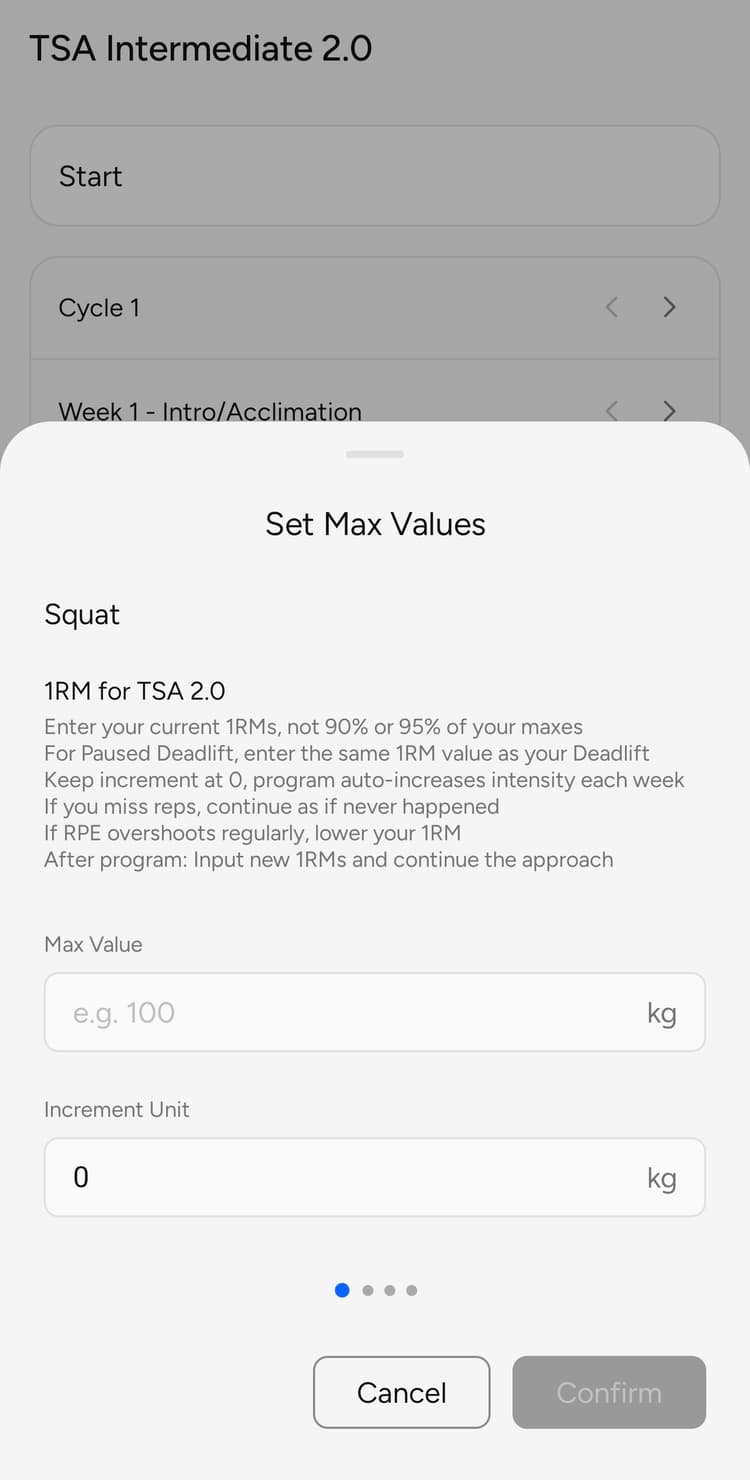
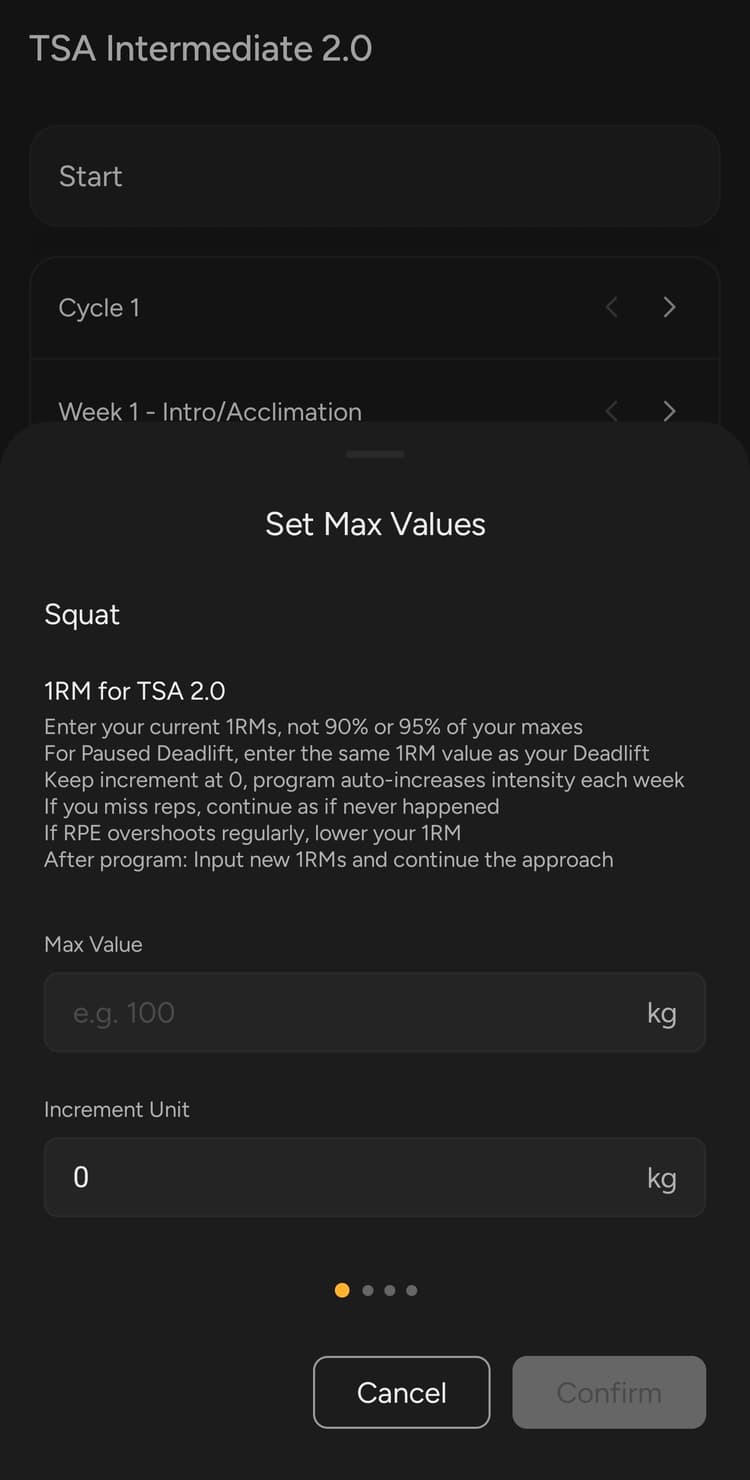
Enter your true 1RM for Squat, Bench, and Deadlift. For Paused Deadlift and 3-Count Paused Bench, enter the same values as their competition counterparts. The increment stays at 0 — the program handles all progression internally across the 9 weeks.
RepCheck includes all five TSA variants: Intermediate 2.0, Intermediate 2.0 Female, Intermediate 1.0, Beginner, and Beginner Female.