nSuns LP Program Guide — High-Volume Linear Progression
A complete breakdown of nSuns LP — the T1/T2 structure, two percentage schemes, TM progression, 4/5/6-day variants, and how to run it in the RepCheck app.
nSuns LP is a high-volume linear progression program created by Reddit user /u/nSuns. It combines the 5/3/1 percentage scheme from Jim Wendler with the high set counts inspired by Sheiko programming. The result is 17 working sets of compound lifts per session — 9 for the primary lift, 8 for the secondary — making it one of the most volume-dense intermediate programs available. It's popular enough to have its own subreddit (r/nSuns).
How It Works
Each training day has two compound lifts plus accessories:
T1 (Primary Lift) — 9 sets with varying percentages and rep ranges based on your Training Max. Includes one or two AMRAP sets that determine your TM increase for next week.
T2 (Secondary Lift) — 8 sets at lighter percentages of a related lift. For example, if T1 is Bench Press, T2 might be OHP or Close-Grip Bench.
Accessories — The program doesn't prescribe specific movements. You choose 2–4 exercises per day targeting weak points. Since 3 out of 5 training days are pressing-heavy (Days 1, 3, and 5 all have pressing movements for both T1 and T2), adding back work (rows, pull-ups, face pulls) on every session is strongly recommended.
Sessions typically run 75–90 minutes for T1 and T2 alone. With accessories, expect closer to 2 hours.
The Two T1 Percentage Schemes
Not all T1 days use the same percentage pattern. There are two distinct schemes:
Scheme A — Bench Day 1 (lighter top sets, higher reps):
| Set | % of TM | Reps |
|---|---|---|
| 1 | 65% | 8 |
| 2 | 75% | 6 |
| 3 | 85% | 4 |
| 4 | 85% | 4 |
| 5 | 85% | 4 |
| 6 | 80% | 5 |
| 7 | 75% | 6 |
| 8 | 70% | 7 |
| 9 | 65% | 8+ (AMRAP) |
The top sets peak at 85% for triples of 4, then descend. The final AMRAP is at 65%.
Scheme B — Squat, Deadlift, OHP, Bench Day 5 (heavier top set, lower reps):
| Set | % of TM | Reps |
|---|---|---|
| 1 | 75% | 5 |
| 2 | 85% | 3 |
| 3 | 95% | 1+ (AMRAP) |
| 4 | 90% | 3 |
| 5 | 85% | 3–5 |
| 6 | 80% | 3–5 |
| 7 | 75% | 3–5 |
| 8 | 70% | 3–5 |
| 9 | 65% | 3–5+ (AMRAP) |
This is the classic 5/3/1 structure — ramp to a 95% single AMRAP, then descend with back-off sets. The rep counts on the back-off sets vary slightly between exercises.
The 95% AMRAP on Scheme B is the key set — this is where your TM adjustment is determined.
T2 Percentages
T2 sets use similar but not identical rep patterns. Upper body T2 lifts (OHP, Incline Bench, Close-Grip Bench) follow a 6/5/3/5/7/4/6/8 pattern, while lower body T2 lifts (Sumo Deadlift, Front Squat) start with 5 instead of 6: 5/5/3/5/7/4/6/8. The percentages also differ by exercise:
| T2 Exercise | Peak % of TM | Working Set % |
|---|---|---|
| OHP (behind Bench T1) | 70% | 50 → 60 → 70% then stay at 70% |
| Sumo Deadlift (behind Squat T1) | 70% | 50 → 60 → 70% then stay at 70% |
| Incline Bench (behind OHP T1) | 60% | 40 → 50 → 60% then stay at 60% |
| Close-Grip Bench (behind Bench T1) | 60% | 40 → 50 → 60% then stay at 60% |
| Front Squat (behind Deadlift T1) | 55% | 35 → 45 → 55% then stay at 55% |
T2 exercises ramp up in the first three sets, then hold at the working percentage for the remaining five sets with varying reps. The heavier T2 lifts (OHP, Sumo DL) peak at 70%, while lighter variants peak lower.
Training Max and Progression
Your Training Max (TM) is 90% of your actual 1RM, same as standard 5/3/1. The difference is how fast it progresses.
After each week, your TM adjusts based on your AMRAP performance on the T1 top set:
| AMRAP Result | TM Adjustment |
|---|---|
| 0–1 reps | No increase |
| 2–3 reps | +5 lb / +2.5 kg |
| 4–5 reps | +5–10 lb / +2.5–5 kg |
| 5+ reps | +10–15 lb / +5–7.5 kg |
This is weekly progression — much faster than standard 5/3/1's monthly cycle of 5 lb/10 lb increases. It's what makes nSuns a linear progression program despite using 5/3/1 percentages.
In RepCheck, lower body lifts (Squat, Deadlift, Sumo DL, Front Squat) use a 2.5 kg base increment, and upper body lifts (Bench, OHP, Incline Bench, CGBP) use a 1.25 kg base increment. These auto-increment each week, and you can manually adjust based on your AMRAP results.
The 5-Day Program (Original)
The 5-Day LP is the original and most popular variant:
| Day | T1 (Primary) | T2 (Secondary) | Accessories |
|---|---|---|---|
| Day 1 | Bench Press (Scheme A) | OHP | Chest, Arms, Back |
| Day 2 | Squat (Scheme B) | Sumo Deadlift | Legs, Abs |
| Day 3 | OHP (Scheme B) | Incline Bench | Shoulders, Chest |
| Day 4 | Deadlift (Scheme B) | Front Squat | Back, Abs |
| Day 5 | Bench Press (Scheme B) | Close-Grip Bench | Arms, Other |
Bench appears twice — once with Scheme A (higher reps, lower intensity) and once with Scheme B (95% AMRAP). Squat, OHP, and Deadlift each appear once as T1 with Scheme B.
Notice that 3 out of 5 days have pressing movements for both T1 and T2 (Days 1, 3, and 5). Back work is entirely absent from the programmed lifts — you need to add rows, pull-ups, or other pulling work as accessories.
Secondary Lift Max Values
T2 exercises share the same TM as their parent lift. When setting up in RepCheck, enter the same 1RM value:
- Sumo Deadlift → use your Deadlift 1RM
- Front Squat → use your Squat 1RM
- Incline Bench Press → use your Bench Press 1RM
- Close-Grip Bench Press → use your Bench Press 1RM
The T2 percentages are already scaled lower (55–70% vs. the parent lift's 65–95%), so sharing the same TM is intentional.
The 4-Day Variant
The 4-Day removes Day 3 (OHP T1 / Incline Bench T2) from the 5-Day program:
| Day | T1 | T2 | Accessories |
|---|---|---|---|
| Day 1 | Bench Press (Scheme A) | OHP | Chest, Arms, Back |
| Day 2 | Squat (Scheme B) | Sumo Deadlift | Legs, Abs |
| Day 3 | Bench Press (Scheme B) | Close-Grip Bench | Arms, Other |
| Day 4 | Deadlift (Scheme B) | Front Squat | Back, Abs |
OHP still appears as a T2 behind Bench on Day 1, but there's no dedicated OHP T1 day. This is a good starting point if you're new to nSuns — Lift Vault recommends running the 4-Day for 2–3 months before moving to 5- or 6-Day.
The 6-Day Variants
Both 6-Day variants take the 5-Day structure and add a sixth volume day focused on one lift.
6-Day Squat: Days 1–5 are identical to the 5-Day. Day 6 adds:
| Exercise | Sets | Weight | Reps |
|---|---|---|---|
| Squat (Volume) | 8 | 72.5% of TM | 3 (one AMRAP set) |
| Sumo Deadlift (Light) | 6 | 56.25% of TM | 3 |
6-Day Deadlift: Same concept but with Deadlift as the volume focus. The day order also shifts — Deadlift T1 moves to Day 2 and Squat T1 moves to Day 4. Day 6 adds:
| Exercise | Sets | Weight | Reps |
|---|---|---|---|
| Deadlift (Volume) | 8 | 72.5% of TM | 3 (one AMRAP set) |
| Front Squat (Light) | 6 | 56.25% of TM | 3 |
The volume day gives the target lift three weekly exposures (T1 day + T2 day + Volume day) instead of two.
Who Is This For?
nSuns works for intermediate lifters who respond well to high volume and want faster weekly progression than standard 5/3/1. It's particularly effective for lifters who have finished beginner programs like Starting Strength or StrongLifts and want aggressive strength gains on the big four lifts.
It's demanding — sessions are long, recovery requirements are high, and the pressing volume is substantial. If you prefer shorter sessions or are training on a caloric deficit, standard 5/3/1 or GZCLP may be better options. Most lifters run nSuns for 12–20 weeks before transitioning to a program with built-in periodization.
Running nSuns in the RepCheck App
When you select any nSuns variant in the RepCheck app, it asks for your TM for each lift:
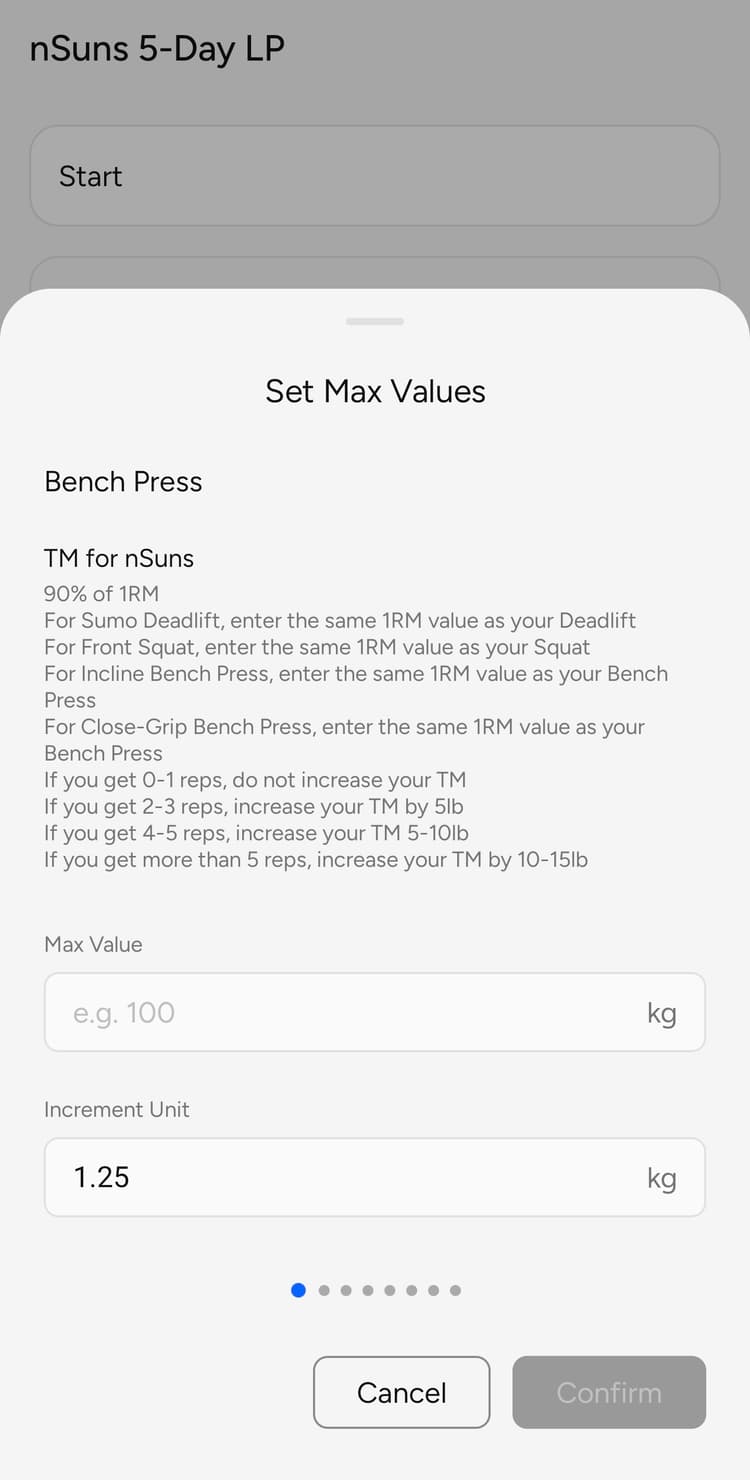
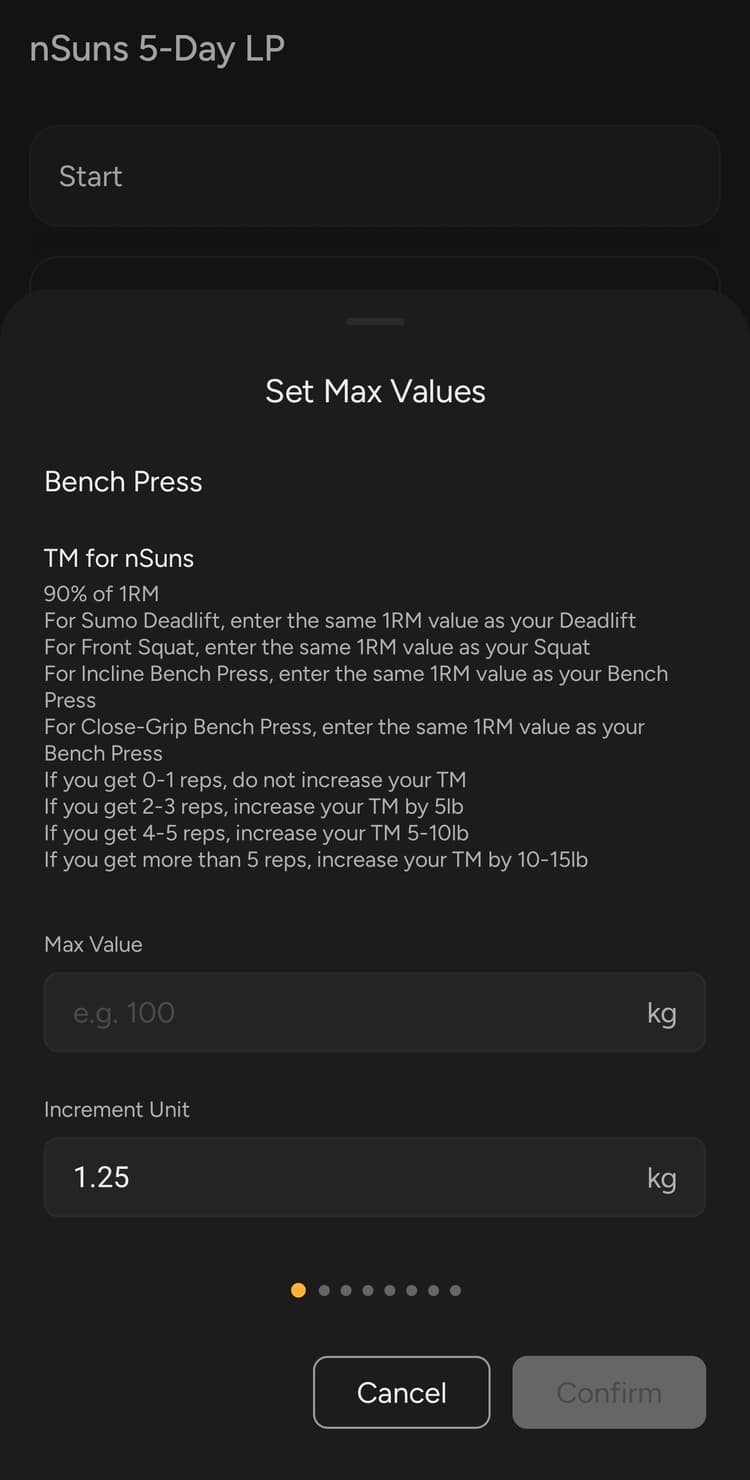
Enter your TM (90% of 1RM) for the four main lifts, plus the same values for their secondary counterparts. RepCheck calculates all 17 sets per session automatically and increments your TM each week. Adjust manually based on your AMRAP performance using the guidelines in the max description.