GZCLP Program Guide — Tiered Linear Progression for Beginners
A complete breakdown of GZCLP — the T1/T2/T3 tier structure, failure protocol, 3-day and 4-day variants, and how to run it in the RepCheck app.
GZCLP is Cody Lefever's linear progression program built on his GZCL method. It organizes exercises into three tiers — T1 (heavy compounds), T2 (lighter compounds), and T3 (accessories) — each with its own rep scheme, progression rules, and failure protocol. Unlike most beginner LP programs that just tell you to "deload 10% and try again," GZCLP shifts the rep scheme when you stall, letting you extract more progress from the same weight before resetting.
The Tier Structure
Tier 1 — Heavy Compound (low reps, high weight) Your main lift for the day: Squat, Bench Press, Deadlift, or OHP. Starts at 5×3+ (5 sets of 3, last set AMRAP capped at 10 reps). Rest 3–5 minutes between sets.
Tier 2 — Light Compound (moderate reps, moderate weight) A secondary compound that supports T1. On Squat day, T2 is Bench; on Bench day, T2 is Squat; and so on. Starts at 3×10. The same four lifts appear as both T1 and T2 on different days, at different weights.
Tier 3 — Accessories (high reps, light weight) Isolation or accessory work targeting weak points and building volume. Starts at 3×15+ (last set AMRAP). The default T3 exercises are Lat Pulldown on Squat and Bench days, and Dumbbell Row on OHP and Deadlift days.
The underlying principle is the 1:2:3 volume ratio — for every rep you do at T1, do roughly 2 reps at T2 and 3 reps at T3. This builds a pyramid where the heaviest work has the least volume, and the lightest work has the most.
T1 Failure Protocol
This is what makes GZCLP different. When you can't complete the required volume, you change the rep scheme instead of deloading:
| Stage | Scheme | Base Volume | What Happens |
|---|---|---|---|
| Stage 1 | 5×3+ | 15 reps | Add weight each session until you fail |
| Stage 2 | 6×2+ | 12 reps | Same weight from failed 5×3+, then add weight |
| Stage 3 | 10×1+ | 10 reps | Same weight from failed 6×2+, then add weight |
| Retest | Find new 5RM | — | Test 5RM, start next cycle at 85% of it |
Each stage shift keeps the same weight but changes the set/rep structure, so you keep training heavy. Only after exhausting all three stages do you retest and reset.
T2 Failure Protocol
T2 follows a similar pattern but resets differently:
| Stage | Scheme | Base Volume | What Happens |
|---|---|---|---|
| Stage 1 | 3×10 | 30 reps | Add weight each session until you fail |
| Stage 2 | 3×8 | 24 reps | Same weight from failed 3×10, then add weight |
| Stage 3 | 3×6 | 18 reps | Same weight from failed 3×8, then add weight |
| Reset | Back to 3×10 | — | Slightly heavier than last successful 3×10 |
No 5RM retest for T2 — you just go back to 3×10 at a slightly heavier weight and run through the stages again.
T3 Progression
T3 is simpler. You stay at 3×15+ and increase weight when you hit 15/15/25 reps (the last set AMRAP reaching 25). There's no stage shifting or reset for T3 — just gradually push the AMRAP higher, then bump the weight up when you reach the threshold.
Increment Rules
Weight increases are per session (not per week), every time you successfully complete the required volume:
- Upper body (Bench, OHP): +2.5 kg per session
- Lower body (Squat, Deadlift): +5 kg per session
AMRAP sets are capped at 10 reps — don't push beyond that even if you have more in the tank. This prevents grinding and keeps rep quality high.
The 4-Day Program
The 4-Day variant runs all four workout templates each week:
| Day | T1 | T2 | T3 |
|---|---|---|---|
| Day 1 (Squat) | Squat 5×3+ | Bench 3×10 | Lat Pulldown 3×15+ |
| Day 2 (OHP) | OHP 5×3+ | Deadlift 3×10 | DB Row 3×15+ |
| Day 3 (Bench) | Bench 5×3+ | Squat 3×10 | Lat Pulldown 3×15+ |
| Day 4 (Deadlift) | Deadlift 5×3+ | OHP 3×10 | DB Row 3×15+ |
Each compound lift appears twice per week — once as T1 (heavy, low reps) and once as T2 (lighter, high reps). The layout pairs upper and lower body lifts on each day to balance the workload.
The 3-Day Program
The 3-Day variant uses the same four workout templates but rotates them across 3 training days per week. It takes 4 weeks to complete the full rotation:
- Week 1: Squat / OHP / Bench
- Week 2: Deadlift / Squat / OHP
- Week 3: Bench / Deadlift / Squat
- Week 4: OHP / Bench / Deadlift
Then the cycle repeats. Each lift still appears as both T1 and T2, just spread across more weeks. This is a good starting point for complete beginners — run the 3-Day for a few months before moving to 4-Day if recovery allows.
Starting Weights
In RepCheck, the max categories describe the starting weight formula:
- T1: 85% of your current 5RM
- T2: 65% of your current 5RM
For example, with a 100 kg Squat 5RM: T1 Squat starts at 85 kg, T2 Squat starts at 65 kg.
Start conservatively. The program is designed to build up — starting too heavy means you'll hit the failure protocol too early and miss the benefit of extended linear progression.
Who Is This For?
GZCLP is for beginners who want a more structured approach than StrongLifts or Starting Strength. The tier system teaches you to prioritize compounds while building a balanced physique through accessories. The failure protocol gives you a clear, multi-stage path when you stall — instead of endlessly deloading.
It's also a good fit for lifters who find 5/3/1 too slow but want more structure than Reddit PPL. Most lifters run GZCLP for 3–6 months before transitioning to an intermediate program like GZCL The Rippler or Jacked & Tan 2.0.
Running GZCLP in the RepCheck App
When you select GZCLP in the RepCheck app, it asks for your starting weights:
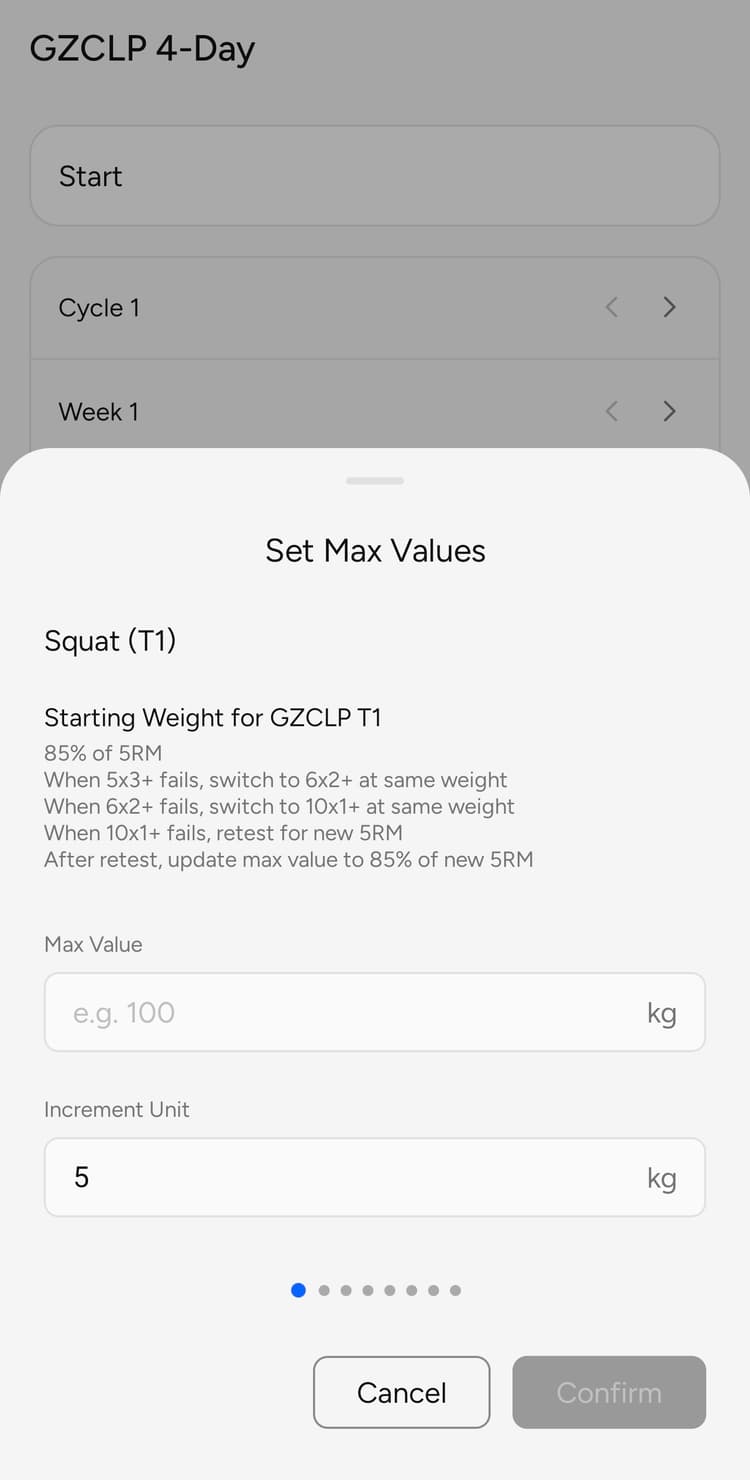
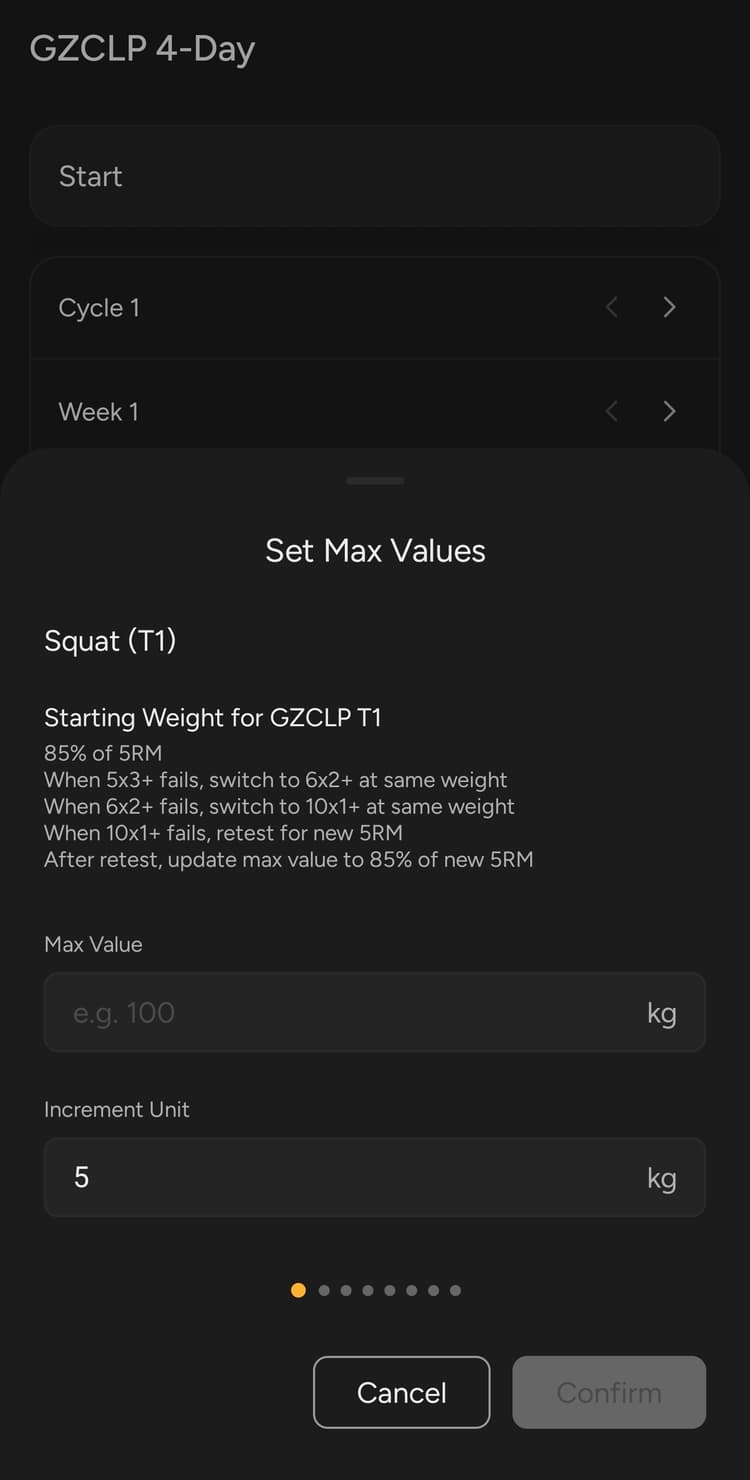
Enter your T1 starting weight (85% of 5RM) and T2 starting weight (65% of 5RM) for each lift. The failure protocol for each tier is explained in the max description. RepCheck includes both 3-Day and 4-Day variants, each running for 12 weeks with automatic increment tracking.